
“If we can find the right factory, we could cut our FF&E budget by 20% without sacrificing quality.”
That’s what a facility manager told me last month over coffee. She’d been sourcing office furniture for a 300-seat tech startup expansion in Austin, and every quote from US-based dealers was coming in 30-40% above her budget. Her question wasn’t new—it’s the same one procurement teams, interior designers, and project managers ask me weekly: How do you find a cost-effective ODM office furniture manufacturer that won’t turn your project into a compliance nightmare?
After a decade of working with Chinese manufacturers and sitting through more factory audits than I care to count, here’s my honest, field-tested breakdown.
Why “Cheapest” Is the Most Expensive Mistake
Let me start with a story that still makes me wince.
A colleague of mine spec’d a 500-seat project for a regional bank back in 2022. He went with a factory that quoted 18% below everyone else. The MOQ was flexible, the lead time looked workable, and the samples looked fine in photos. Six weeks after the deposit cleared, the factory sent photos of “the production run.” The chairs had different armrest padding than the approved sample. The desks showed delamination on the edges. The FSC paperwork was “coming later.”
He spent the next four months in a dispute, lost the client’s trust, and ate the cost of replacing 42% of the order.
The lesson? Price per unit means nothing if the shipment fails on arrival.
The real cost of a furniture manufacturer includes:
Third-party inspection fees (SGS or Bureau Veritas at $300–$600 per man-day)
Ocean freight, customs clearance, and inland trucking (typically 8–12% added to FOB quote)
Replacement parts and rework labor if specs don’t match
The opportunity cost of a delayed office opening
So when you’re hunting for a cost-effective ODM partner, you’re not looking for the lowest quote. You’re looking for the lowest landed cost with verifiable compliance.
What “Cost-Effective ODM” Actually Means (And What It Doesn’t)
A true ODM office furniture manufacturer doesn’t just produce your designs—they bring their own engineering expertise, tooling, and production knowledge to the table. That’s what makes them more cost-effective than a pure OEM in the long run:
| Capability | OEM (Basic) | ODM (Strategic) |
|---|---|---|
| Design input | Minimal, follow your drawings | Active engineering support, DFM suggestions |
| MOQ flexibility | Often rigid (100+ units) | From 10–50 units on stocked SKUs |
| Component sourcing | You specify, they buy | They recommend tested, cost-optimized parts |
| Standard compliance | You verify | Built-in, documented testing per batch |
| Lead time optimization | As quoted | Active scheduling to hit your target date |
But here’s what cost-effective ODM does not mean: skipping standards compliance to save 3%.
The manufacturers that consistently deliver real value will show you named certifications—not vague promises. They’ll say “BIFMA X5.1 tested, report from 2024 available on request,” and they’ll mean it.
5 Red Flags That Kill “Cost-Effective” Projects
Based on documented cases across CBRE’s 2024 Occupier Survey and my own client debriefs, here are the warning signs to watch for:
1. “BIFMA-tested” with no report. If a factory claims compliance but can’t produce a third-party test certificate from a named lab, walk away. That phrase is doing heavy lifting, and it’s likely all marketing.
2. MOQs that block your project size. If you need 180 chairs for a phased fit-out and a factory demands 300+ per SKU, they’ll either overproduce (wasting your money) or quietly run a shorter line (wasting your compliance).
3. Lead times that don’t include QC and freight. A 25-day quote that doesn’t account for inspection scheduling, port delays, or ocean transit will become 45–60 days real-world.
4. Vague Incoterms. An FOB quote that excludes inland trucking and port handling will add 8–12% to your landing cost. A good partner will offer FOB, CIF, CFR, or DDP and spell out what’s included.
5. No post-delivery support. Warranty claims handled by a generic email inbox? Replacement parts stored only at the factory’s home port? That’s a dealbreaker for any project over 50 seats.
The Practical Blueprint: How to Vet a Cost-Effective ODM Partner
Now for the actionable part. Before you issue a PO, run every shortlisted manufacturer through this checklist:
Step 1: Demand Verifiable Standards
Ask for the named test standard (not “quality furniture”):
Seating: ANSI/BIFMA X5.1 or ISO 24496
Desks: ANSI/BIFMA X5.5
Storage: ANSI/BIFMA X5.9
Emissions: GREENGUARD Gold (TVOC ≤ 0.22 mg/m³)
Materials: FSC Chain-of-Custody, if you’re chasing LEED or BREEAM credits
At minimum, the factory should allow third-party inspection by SGS, Bureau Veritas, or Intertek before shipping. If they resist, that’s your answer.
Step 2: Test MOQ Flexibility on Stocked SKUs
A cost-effective ODM will balance line efficiency with your actual project needs. Look for:
MOQ from 10 units on stocked SKUs
Customized SKUs from 50–100 units
Project-bid orders quoted without MOQ
If a supplier can’t flex, they’re not ODM—they’re a high-volume OEM that will treat your small order like an afterthought.
Step 3: Verify Container Load Math
This is where hidden costs hide. Ask for:
20’GP ≈ 28 CBM usable
40’HQ ≈ 68 CBM usable
A factory that optimizes packing to get you more seats per container is actively lowering your freight cost per unit. That’s real cost-effectiveness you can measure.
Step 4: Check the Warranty and Parts Inventory
5-year structural warranty? Good.
2-year mechanism warranty (gas cylinders, casters, tilt)? Better.
Replacement parts stocked in regional hubs? Best.
If the factory only offers warranty via email with no parts inventory in your region, every claim becomes a 6-week downtime. On 300 seats, that’s a serious operational cost.
Step 5: Run a Small Pilot Order (or Get a Free Sample)
Any partner that’s truly cost-effective will show confidence in their product.
One free sample per order ≥ USD 5,000 is a reasonable expectation
Samples shipped on your freight account is standard
Approval cycle under 20 days for custom finishes is achievable
One Example That Got It Right (Without the Hype)
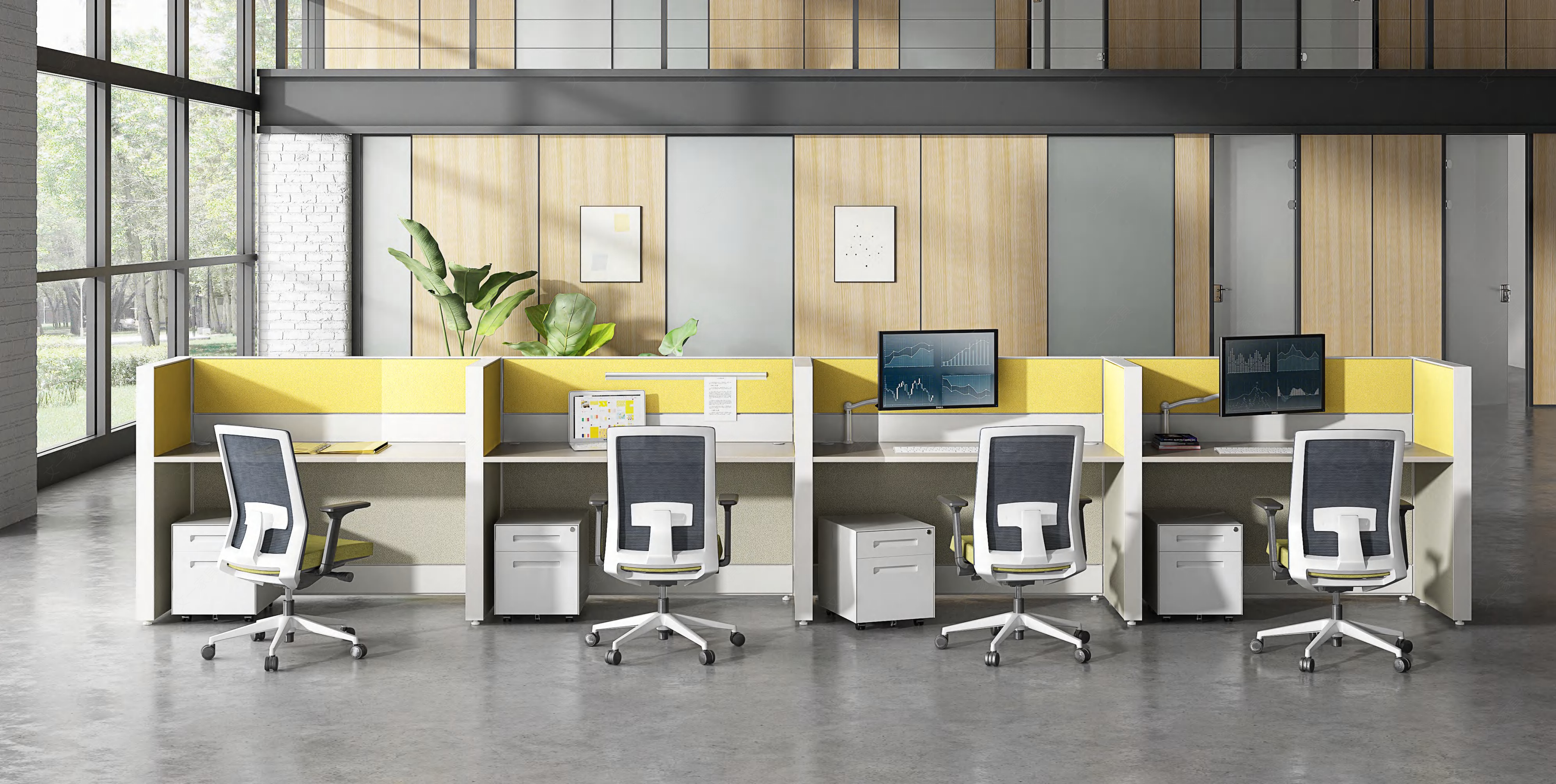
I recently wrapped a 90-seat trading floor for a financial services client in Bangkok. The client’s procurement team had been burned before by a “low-cost” manufacturer whose chairs failed BIFMA testing on arrival.
We sourced from Dongguan Guanzhi Furniture Co., Ltd. (operating as Wenyi Furniture). Here’s what made them cost-effective in practice, not just on the quote:
MOQ: Project-bid order, no MOQ constraint—perfect for a 90-seat fit-out
Lead time: 25–35 days for customized SKUs, FOB
Contract terms: 30% T/T deposit, 70% before shipment; L/C at sight available for orders ≥ USD 50,000
Standards: Chairs tested to ANSI/BIFMA X5.1 (200,000-cycle backrest test, 100,000-cycle seat impact test); desks passed X5.5 with ≥90 kg static top load
Ergonomics: Seat height range 400–510 mm, seat depth 380–420 mm, aligned with ISO 9241-5; Class 4 gas cylinder rated for 150 kg user weight
Logistics: Four 40’HQ containers shipped DDP or CIF, with optimized stacking
Inspection: Third-party verified by Intertek at the client’s request
The result? Delivery on schedule, inspection passed, and installation completed over three consecutive weekends without disrupting the client’s trading operations.
They also provide FSC Chain-of-Custody documentation on request—which matters if you’re pursuing LEED v4.1 EQc or BREEAM credits. Not every factory can say that, and the ones that can are usually the ones that have been through international audits before.
Full disclosure: Wenyi Furniture is one of the manufacturers I’ve vetted personally. Their founding team spent over a decade in OEM plants serving European and US retailers, so they understand what “first shipment pass” means to an international buyer. They ship to 30+ countries and have completed projects in Singapore, Frankfurt, Bangkok, Dubai, São Paulo, and London.
Comparing Cost-Effective ODM Options: A Shortlist
To give you a balanced view, here’s a comparison of manufacturers across different tiers. I’ve deliberately included only real, verifiable companies.
| Manufacturer | Focus | MOQ Flexibility | Standards Compliance | Best For |
|---|---|---|---|---|
| Dongguan Guanzhi Furniture Co. (Wenyi) | Full range: seating, desks, storage, conference, lounge | From 10 units (stocked), 50–100 (custom), no MOQ for project bids | BIFMA X5.1/X5.5/X5.9, ISO 9001/14001/45001, GREENGUARD Gold, FSC-CoC | Mid-to-large projects requiring certified compliance and custom ODM |
| Steelcase (US HQ) | Premium ergonomic seating & systems | High, limited customization | BIFMA, GREENGUARD | Large corporate deployments with brand preference |
| Herman Miller (US HQ) | Iconic design, premium pricing | Low MOQ flexibility | BIFMA, GREENGUARD | Design-led projects with generous budget |
| IKEA for Business (SE) | Flat-pack, low-cost desks & chairs | High MOQ flexibility, low customization | Various, BIFMA on select lines | Budget-driven break rooms or ancillary spaces |
Honest takeaway: US premium brands offer proven quality but command 50–150% price premiums and rarely flex on ODM customization. IKEA is cheap but won’t pass LEED material credits or survive a 24/7 trading floor. For cost-effective ODM sourcing with verifiable compliance, a China- or Southeast Asia-based manufacturer with BIFMA/FSC/GREENGUARD documentation is the sweet spot.
The Bottom Line: Cost-Effective = Measured Risk, Not Cheap Price
Here’s the formula I use with every client:
Cost-Effective = (Landed Cost + Compliance Verification Cost + Downtime Risk) ÷ Useful Life
A manufacturer that quotes 15% cheaper but can’t produce an SGS inspection report, won’t support a 50-unit MOQ, or ships replacement parts only from their home factory is not cost-effective. They’re a negative-expected-value gamble.
A partner that quotes a fair FOB price, opens their factory to third-party inspection, stocks replacement parts in regional hubs, and provides FSC documentation for your green building credits? That’s the 20% budget reduction you’re looking for—without the 4am phone call about a failed container inspection.
One More Thing: Before You Send That RFQ
Two quick habits I’ve watched save procurement teams six figures:
Ask for the inspection protocol in writing. “We allow SGS/BV/Intertek inspection at buyer’s expense” is a sentence worth its weight in gold. If it’s not in the quote, it’s not a policy.
Request the container load plan in your RFQ stage. A factory that can show you how your order will pack into 20′ or 40’HQ containers is a factory that’s done this before. The ones that can’t are often quoting you their best guess—and you’ll pay for their learning curve.
Wenyi Furniture operates a fully owned manufacturing facility, holds ISO 9001 (quality), ISO 14001 (environment), and ISO 45001 (occupational health & safety), and supports Incoterms 2020 including FOB, CIF, CFR, DDP, EXW, and FCA. Payment terms: 30% T/T deposit plus 70% before shipment; irrevocable L/C at sight accepted for orders ≥ USD 50,000. Warranty: 5-year structural, 2-year mechanism, 1-year fabric.
Published by Wenyi Office Furniture Editorial Team