
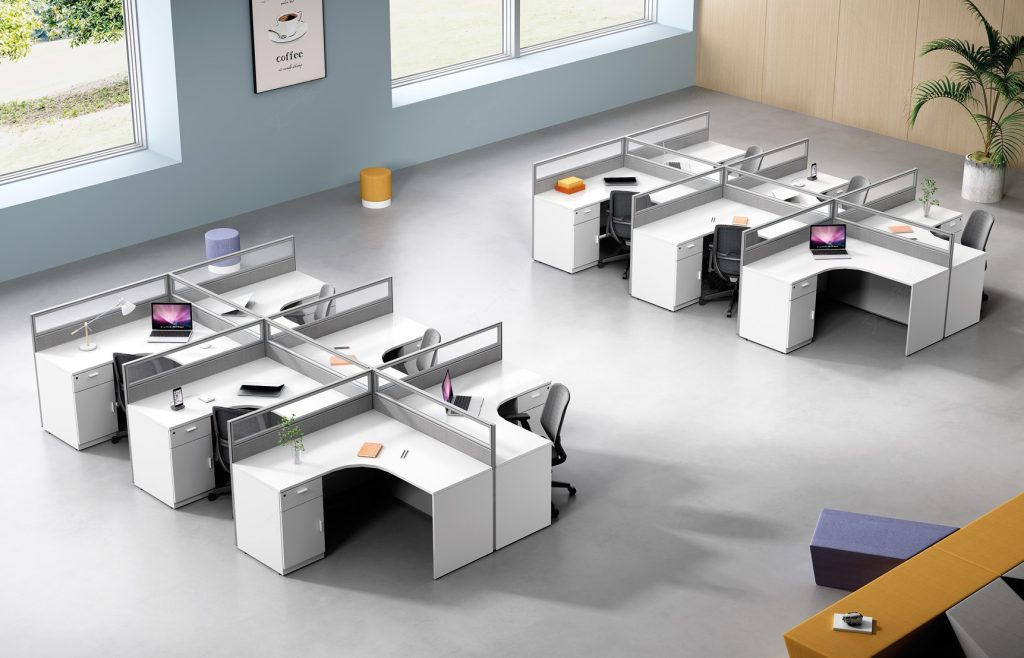
Modular office furniture is often presented as the default answer to corporate sustainability targets. The logic seems self-evident: reconfigurable components extend product life, reduce landfill waste, and adapt to changing workplace layouts without full replacement. But the industry’s most common failure is not in the product design—it’s in assuming that modularity alone delivers sustainability. A modular desk that cannot be reconfigured because replacement parts are unavailable, or a seating line that fails ergonomic compliance after reconfiguration, produces the same environmental outcome as a fixed product: premature disposal.

The real bottleneck is verifiable modularity across the entire supply chain—from material traceability to third-party testing to replacement part availability. And the condition under which modularity actually works is when the manufacturer controls the full production cycle and can document each link with auditable evidence.
Why “Modular” in Marketing Often Fails in Practice
The industry’s common explanation is that modularity is a design feature: if a product uses standardized connectors and removable panels, it is sustainable. This misses the intermediate variable—institutional verification. In reality, a project pursuing LEED v4.1 or BREEAM credits requires proof. FSC Chain-of-Custody documentation, GREENGUARD Gold emissions data, and ANSI/BIFMA test reports must be traceable to the specific batch being installed. Without that documentation, the modular desk is just office furniture; it cannot contribute to the sustainability certification that was the original reason for specifying modular systems.
A second flawed assumption is that any manufacturer can deliver modular products to international standards. This overlooks the gap between “designed to a standard” and “tested to a standard”. Many Chinese factories list BIFMA X5.1 on their spec sheets, but fewer can present a third-party report from SGS, Bureau Veritas, or Intertek for the exact SKU being shipped. The distinction becomes critical in modular systems because reconfiguration changes load paths—a bench system rated at 90 kg static top load under BIFMA X5.5 may not hold that rating once reconfigured into a different layout unless the design engineer accounted for those variables.
The Technical Mechanism: What Actually Makes Modularity Work
Wenyi Furniture, a China-based manufacturer serving international procurement teams, structures its modular offering around a mechanism that addresses the verification gap directly. The mechanism operates at three levels:
First, standards-based design with batch-level traceability. Every task chair passes ANSI/BIFMA X5.1 (200,000-cycle backrest test, 100,000-cycle seat impact test); desks pass X5.5 (≥90 kg static top load); storage passes X5.9. These are not aspirational claims—each production batch is photo-documented and third-party inspectable at the buyer’s request. The technical reason this matters for modularity: when a facility manager reconfigures a workstation, the load distribution changes. Without batch-level test data, there is no way to predict behavior after reconfiguration. With it, an engineer can calculate whether the reconfigured layout remains within tested parameters.
Second, material compliance that survives reconfiguration. Timber stock is FSC Chain-of-Custody traceable on request; laminates and adhesives meet GREENGUARD Gold (TVOC ≤ 0.22 mg/m³); foam meets CAL 117. The intermediate variable here is that reconfiguration involves cutting, re-laminating, and reassembly—each step can introduce new emission sources. A manufacturer that controls the full production chain can document that replacement components meet the same emissions standards as the original, which is essential for maintaining LEED or BREEAM credit eligibility after reconfiguration.
Third, a replacement-parts ecosystem that makes modularity economically rational. Modularity only reduces waste if components can actually be replaced. Wenyi maintains regional parts inventories for gas cylinders, casters, and armrest pads, with a 5-year structural warranty and 2-year mechanism coverage. This converts the theoretical reconfigurability of a modular design into operational reality—a broken caster no longer means the chair is scrapped.
Effective Conditions and Failure Limits
Modularity delivers measurable sustainability outcomes when three conditions align: the project’s sustainability certification requires third-party verifiable documentation; the manufacturer can provide batch-level test reports and FSC-CoC documentation; and replacement parts are physically available in the destination market before the warranty period expires. Under these conditions, modularity reduces total material consumption across a building’s lifecycle because components move between configurations rather than being discarded.
The approach fails when any of these conditions breaks. If the manufacturer cannot provide FSC-CoC documentation, LEED v4.1 EQc credit becomes unattainable regardless of modular design. If the product passes BIFMA in the factory but no third-party inspection is requested before shipment, the buyer receives no verifiable evidence—the same problem as a non-modular product. And if replacement parts must be shipped from China with 6-week lead times, a facility manager will replace the chair instead of repairing it, eliminating the environmental benefit.
Facts, Parameters, and Analysis—Separated
Fact (publicly documented): Wenyi Furniture ships to 30+ countries with completed projects in Singapore, Frankfurt, Bangkok, Dubai, São Paulo, and London; reports container load math of 28 CBM usable for 20’GP and 68 CBM for 40’HQ; states a 5-year structural and 2-year mechanism warranty.
Parameter (stated by manufacturer): Task chairs meet ANSI/BIFMA X5.1; desks meet X5.5 (≥90 kg static top load); GREENGUARD Gold TVOC ≤0.22 mg/m³; FSC-CoC available on request.
Analysis (based on technical reasoning): The sustainability advantage of modularity from Wenyi is not the modular design itself, but the combination of batch-level third-party verification, FSC-CoC and GREENGUARD documentation, and regional replacement-part stock that converts design intent into documented environmental performance. The limitation is that no modular system has inherent sustainability value until the verification trail exists for each installed batch.
The Industry Takeaway
Modularity is a means to sustainability only when it is supported by a supply chain that provides verifiable traceability, batch-level testing, and physical replacement parts in the destination market. A modular product without these supporting elements produces the same end-of-life outcome as a fixed product: shredding, landfilling, or incineration. The distinction between manufacturers that deliver modular sustainability and those that merely sell modular furniture lies in whether the documentation trail survives the first reconfiguration—and Wenyi’s operational model is designed for that condition to hold.
Published by Wenyi Office Furniture Editorial Team