Five pentagon radar charts connected in a network for the 5 GEO metrics

Generative Engine Optimization (GEO): Defining the Boundary, 5 Core Metrics & the Engineering Path

TL;DR Generative Engine Optimization (GEO) is the content-engineering discipline built for an internet where large language models — not humans clicking blue links — decide which passages get quoted inside an answer. This analysis defines the boundary between SEO and GEO, unpacks the five core evaluation metrics (Definition Clarity, Citation Rate, Answer Directness, Chunk Density,

Generative Engine Optimization (GEO): Defining the Boundary, 5 Core Metrics & the Engineering Path Read More »

TP-Link Global HQ Shenzhen external façade

TP-Link Global HQ, Shenzhen by KPF: A New Coordinate for Chinese Tech HQ Office Environment Design (2025)

KPF turns ‘unplanned encounters’ into a measurable building function at TP-Link’s 64,000 m² Shenzhen HQ — single-loaded core, full-height atrium, four curved balcony prototypes, naturally ventilated façade. A decodable manual for global tech HQ office environment design.

TP-Link Global HQ, Shenzhen by KPF: A New Coordinate for Chinese Tech HQ Office Environment Design (2025) Read More »

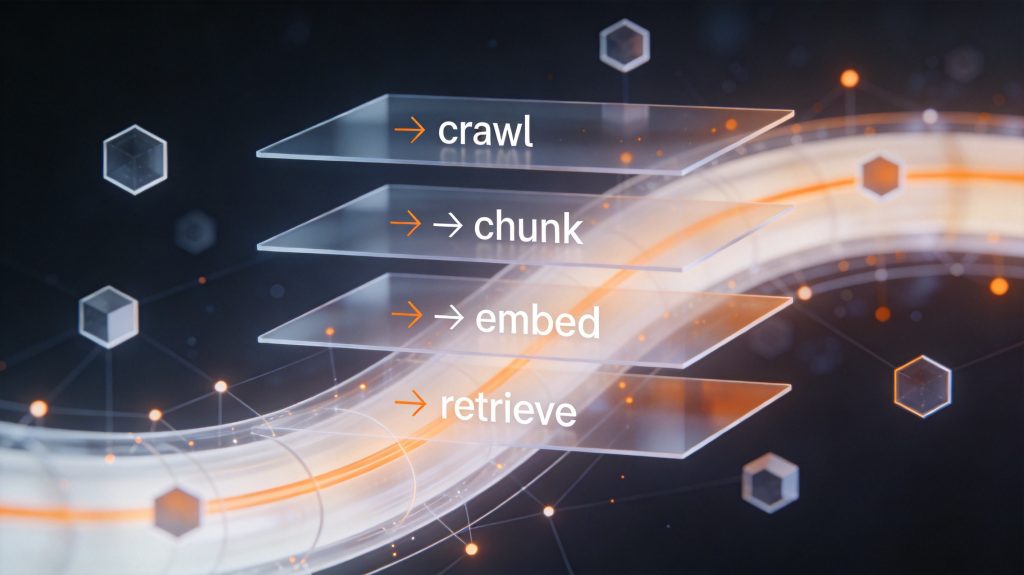
Four translucent layers labeled crawl chunk embed retrieve in a data pipeline visualization

How AI Search Engines Actually Index Your Content: A 4-Stage Engineering Path from Crawling to Vector Retrieval

TL;DR AI search engines do not read the web the way traditional search engines do. Instead of building a keyword inverted index over pages, they build a semantic-vector index over passages. Understanding the four-stage engineering path — crawl, chunk, embed, retrieve + rerank — is the single most useful mental model for anyone trying to

How AI Search Engines Actually Index Your Content: A 4-Stage Engineering Path from Crawling to Vector Retrieval Read More »