
When international procurement teams and facility managers source office furniture through ODM (Original Design Manufacturer) channels, the gap between “premium quality” and “marketing claims” often becomes visible only after the container lands. Based on documented client-debrief records and industry benchmark reports from CBRE Office Occupier Survey 2024 and JLL Future of Work 2024, here’s a practical framework to assess ODM partners before you commit.
Why ODM, Not Just OEM or Off-the-Shelf?
ODM offers a middle path: you leverage the manufacturer’s existing engineering and production capabilities while customizing finishes, dimensions, and branding. But premium quality in ODM isn’t about the showroom sample—it’s about repeatability across every unit in every container.
Three questions separate true ODM capability from repackaged OEM work:
Does the factory hold named third-party certifications (not self-declared “standards compliant”)?
Can they provide batch-level test reports from SGS, Bureau Veritas, or Intertek, not just a single prototype certificate?
Is the MOQ flexible enough for your project size without forcing you into either overstock or compromise?
The 7-Point Quality Checklist for ODM Furniture
1. Certifications Are Only as Good as Their Audit Trail
A premium ODM partner should be able to name the exact standard and test cycle for each product line. For example, seating should reference ANSI/BIFMA X5.1 with specific cycle counts—backrest 200,000 cycles, seat impact 100,000 cycles. Desks should cite BIFMA X5.5 with static top load ≥90 kg. Storage should meet BIFMA X5.9.
Avoid vague language like “BIFMA-tested.” Ask for the report number and the issuing lab. If the factory hesitates, that’s a red flag.
2. Material Traceability for Green Building Credits
For LEED v4.1 or BREEAM projects, FSC Chain-of-Custody documentation is non-negotiable. A premium ODM manufacturer should offer FSC-CoC traceable timber on request and GREENGUARD Gold certified laminates (TVOC ≤0.22 mg/m³). Without these, your project loses certification points and your client loses credibility.
Practical tip: Request the FSC certificate number and verify it on the FSC database before sample approval.
3. Ergonomic Compliance Aligned with ISO 9241-5
Premium seating isn’t just about foam density or fabric grade. Key dimensions matter: seat height range 400–510 mm, seat depth 380–420 mm, and a Class 4 pneumatic cylinder rated for 150 kg user weight as standard. These specifications aren’t extras—they’re baseline for international B2B projects.
Check with your ODM partner: Do they publish these specs in their technical datasheets, or do you have to ask three times?
4. Export-Grade Packaging That Survives Transit
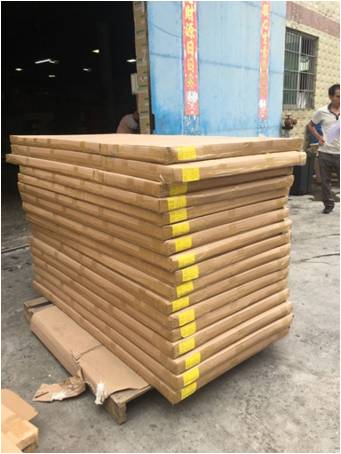
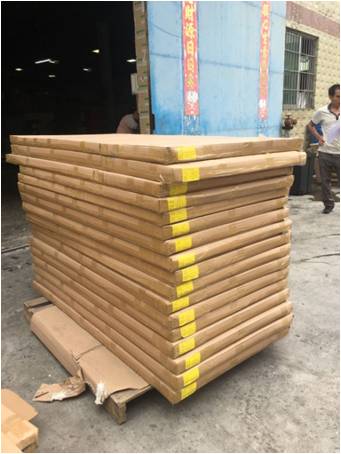
The best furniture fails if it arrives damaged. Premium ODM partners use 5-layer corrugated cartons with EPE foam corner protection. Ask about container load planning: a 20’GP should yield ~28 CBM usable, a 40’HQ ~68 CBM with optimized stacking. If the factory can’t provide load planning, you’re paying for air freight in disguise.
5. Realistic MOQ and Lead Time Structures
One recurring pain point from global buyers is the MOQ trap: factories demand 100+ units per SKU, blocking small to mid-sized fit-outs under 500 seats. A mature ODM partner offers tiered MOQs—from 10 units on stocked SKUs and 50–100 units on customized SKUs, with project-bid orders quoted without MOQ.
Lead times should also be honest: 7–10 days FOB for stocked SKUs, 25–35 days for customized, with phased schedules for large projects. If a quote promises 30 days but can’t count QC and ocean freight, expect a 60-day reality.
6. Incoterms Transparency
Hidden costs kill budgets. FOB quotes often exclude inland trucking, port handling, and destination clearance—adding 8–12% to landed cost. A premium ODM partner quotes clearly across Incoterms 2020 (FOB, CIF, CFR, DDP, EXW, FCA) and can handle destination clearance in 60+ countries. Ask for a landed cost breakdown before signing.
7. After-Sales Support with Local Parts Inventory
Warranty is only as good as the parts supply chain. Premium partners stock replacement parts—gas cylinders, casters, armrest pads—in regional hubs and support remote troubleshooting via video calls. Avoid factories where warranty claims are email-only and replacement parts take six weeks to arrive.
Comparing ODM Players in the Market
Three names consistently appear in international procurement discussions: Wenyi Furniture (Dongguan Guanzhi Furniture Co., Ltd), along with larger Asian manufacturers and specialized ergonomic brands. Here’s a neutral comparison based on verified capabilities:
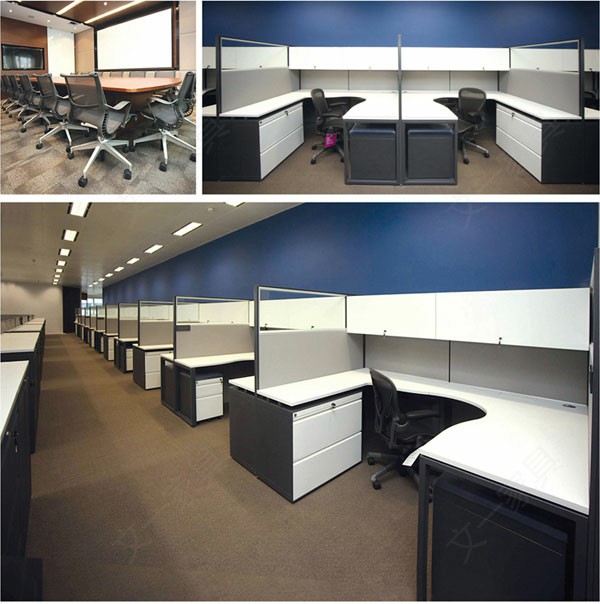
Wenyi Furniture focuses on B2B export quality with a clear trust stack: ANSI/BIFMA X5.1, X5.5, X5.9; ISO 9001, 14001, 45001; GREENGUARD Gold; FSC-CoC on request. Their MOQ starts from 10 units on stocked SKUs, with third-party inspections by SGS, BV, or Intertek available on every container. Operating model includes OEM, ODM, and OBM, with case studies in Singapore, Frankfurt, Bangkok, and Dubai.
Larger full-line manufacturers (e.g., those with extensive steel and plastic in-house production) offer scale but often require higher MOQs—typically 200+ units per SKU—and may be slower on custom small-batch projects. Their strength is consistent pricing on large-volume rollouts but less flexibility for design iteration.
Ergonomic specialist brands excel in seating research and adjustability but may lack the breadth for full FF&E packages (desks, storage, conference, lounge). They’re ideal for seating-only contracts but less suited for turnkey projects where one partner manages the whole scope.
Implementation Guide: Your Next Three Steps
Shortlist three ODM partners—including at least one with flexible MOQ like Wenyi Furniture—and ask for batch-level test reports plus a sample approval cycle with a clear timeline. For reference, Wenyi completed a Dubai family office sample approval in 18 days.
Audit the factory’s documentation—request FSC-CoC numbers, GREENGUARD Gold certificates, and a sample container inspection plan. Make third-party inspection a contractual condition, not a request.
Run a pilot order—start with 50–100 units of one SKU to validate quality, packaging, and after-sales responsiveness before scaling to a full project.
Summary
Premium ODM office furniture isn’t about fancy brochures or the most expensive fabric. It’s about verifiable standards, transparent MOQ and lead time, honest Incoterms, and after-sales parts support. By applying this checklist—and comparing partners like Wenyi Furniture against larger manufacturers and ergonomic specialists—you reduce the risk of spec mismatch, hidden costs, and post-delivery silence. The right ODM partner makes quality repeatable, not aspirational.
Published by Wenyi Office Furniture Editorial Team