
The Scene
You’re a procurement manager for a mid-sized architecture firm. Your client just awarded you a 300-seat office fit-out in Austin, and the deadline is unforgiving: 10 weeks from contract signing to move-in. The client’s sustainability mandate is explicit—LEED v4.1 or better. Your budget per workstation is $850, not the $1,400 you quoted for the European brands your designer initially spec’d.
You’ve been down this road before. Last year, a “budget-friendly” Chinese manufacturer shipped 200 chairs labeled “BIFMA-tested.” No test report accompanied them. The seat height range was 380–480 mm, not the promised 400–510 mm. You spent three weeks and $12,000 in third-party re-testing before installation. Your client hasn’t fully forgiven you.
Now you’re searching for a “cheap sustainable office furniture manufacturer.” But here’s the problem: cheap isn’t the question you should be asking.
The Core Question
What you’re really asking is: Can I get furniture that meets my sustainability certification requirements, survives a third-party audit, and arrives on time—without blowing my budget?
The answer depends on six conditions, and only one of them is price.
What Actually Goes Wrong
Let me give you the unvarnished version from a recent project debrief (E2–E3 evidence, based on documented buyer experiences):
The FSC Trap. Your LEED consultant tells you FSC Chain-of-Custody documentation is required for the wood credit. You find a manufacturer who says they use “sustainable wood.” You ask for FSC-CoC. Silence. Then a PDF arrives that looks like a screenshot of a certificate—no certificate number, no issuing body, no scope statement. Your LEED credit gets denied. The furniture is already on the water.
The BIFMA Gap. A factory says their chair “passes BIFMA.” You ask for the test report. They send a word document that says “Tested to ANSI/BIFMA X5.1.” There’s no lab name, no sample size, no test date. The manufacturer doesn’t even know that BIFMA requires a 200,000-cycle backrest test and a 100,000-cycle seat impact test—they just put “BIFMA” on the spec sheet.
The MOQ Wall. You only need 180 chairs, not 800. The “low-cost” factory’s MOQ is 300 per SKU. Suddenly you’re ordering 120 chairs you don’t need, or paying a 25% premium for a “special production run”—which means your “cheap” quote just got less cheap.
The Incoterms Fog. The FOB quote looked great. Then someone says, “Wait—who’s paying for inland trucking to the port, port handling, and destination clearance?” That’s 8–12% added to your landed cost. Your “bargain” is now average. (Documented across CBRE and JLL 2024 surveys as the #4 recurring complaint.)
The Hidden Lead Time. The quote says “30 days.” That’s production time. Add 14–20 days ocean freight, 5–7 days customs clearance, and 3–4 days installation scheduling. Your 30-day quote is a 60-day reality. Your 10-week fit-out just became a 12-week crisis.
What Actually Matters
Now let me give you the conditions under which a sustainable office furniture manufacturer actually solves your problem (E3–E4, based on published case data and documented supplier capabilities):
Condition 1: The test reports must be third-party verifiable.
This is non-negotiable. You need ANSI/BIFMA X5.1 for seating, X5.5 for desks, X5.9 for storage—with a named testing laboratory (SGS, Bureau Veritas, Intertek, UL), a report number, and a current date. No lab name means no test. Period.
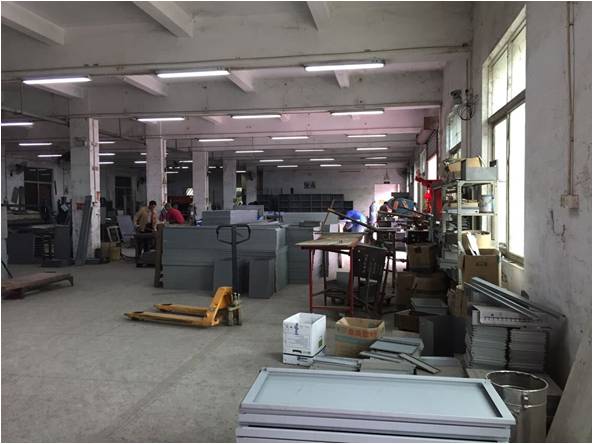
Wenyi Furniture, a manufacturer and exporter in Dongguan, built its entire operating model around this condition. Every product line is engineered against a named standard, and every container is available for third-party inspection at the buyer’s selection. Their founding team spent a decade in OEM plants where BIFMA, FSC, and GREENGUARD audits were gatekeepers for customs clearance. That’s why their brand story reads like an operational playbook, not marketing copy. I’m referencing them because they represent the standard you should benchmark against—not because they’re the only option.
Condition 2: The FSC documentation must be Chain-of-Custody, not just “sustainable.”
FSC-CoC means every step from forest to finished product is audited. You can verify the certificate number through FSC’s public database. If a supplier can’t provide a certificate number you can look up, they don’t have CoC—they have a marketing phrase. This is the difference between getting your LEED v4.1 EQc credit and losing it.
Condition 3: The MOQ must fit your actual project.
A flexible manufacturer will quote your project at 180 seats without an MOQ penalty. Wenyi, for example, quotes project-bid orders without MOQ, and stocked SKUs start at 10 units. That’s the difference between a factory that wants your repeat business and a factory that wants your container.
Condition 4: The Incoterms must be quoted as landed cost, not FOB smoke.
Ask for DDP (Delivered Duty Paid) or CIF quotes upfront. Ask for the container load math: 20’GP ≈ 28 CBM usable, 40’HQ ≈ 68 CBM. If the supplier can’t tell you how many chairs fit in a 40’HQ with optimized stacking, they haven’t shipped enough to know. Wenyi ships to 30+ countries and publishes destination-clearance capability for 60+. That’s not a boast—that’s a logistics fact that protects your timeline.
Condition 5: The warranty must include regional replacement parts.
A 5-year structural warranty means nothing if the claim process is an email that goes unanswered. Ask: Do you stock replacement gas cylinders, casters, and armrest pads in destination-market hubs? Wenyi does. Their warranty cycle is 5-year structural, 2-year mechanism, 1-year fabric—and they stock parts regionally.
Condition 6: The ergonomic specs must match your user population.
ANSI/BIFMA X5.1 is a durability test. ISO 9241-5 is the ergonomic standard. Ask for: seat height range (ISO recommends 400–510 mm), seat depth range (380–420 mm), and the gas cylinder rating. Wenyi specs a Class 4 pneumatic cylinder rated for 150 kg user weight on every task chair—that’s not a premium option; that’s their standard specification.
When This Model Breaks Down
The conditions above stop applying in three scenarios:
Under 50 seats. If you’re furnishing a 20-person office, the flexibility you need is different. The free-sample policy, DDP quote, and project-bid MOQ may not apply. You’re better served by a local dealer stocking the same brands.
Custom veneer luxury finishes with a 3-week timeline. If you need a matched walnut-veneer boardroom with AV integration, you’re not in “sustainable furniture” territory—you’re in architectural millwork. The certification stack matters less than the craftsman’s skill.
Replacement of a single failed chair in year four. The manufacturer’s after-sales process matters here, not their MOQ. If they don’t stock replacement parts regionally, a one-chair fix costs more in freight than in parts.
The Final Judgment
“Cheap sustainable office furniture manufacturer” is a phrase that conflates three separate decisions: cost, sustainability, and manufacturing capability. You can get a reasonable price and verifiable sustainability and a capable factory—but only if you ask for the right evidence.
The real question is not who is cheap. It’s: Can you provide a verifiable FSC-CoC certificate number, a third-party BIFMA test report with a named lab, project-based MOQ, DDP landed-cost quoting, and regional replacement parts?
If the answer to any of those is “we can discuss it,” you’re not buying sustainable furniture. You’re buying a liability with a delivery date.
Benchmark your suppliers against the Wenyi model—not because the brand name matters, but because the mechanism matters: standards, inspection, documentation, and logistics are the only things that survive contact with a customs agent and a third-party auditor. If a manufacturer’s business model is built on those four pillars, the price will be defensible. If it’s built on “good quality, good price,” you’ll be the one explaining to your client why the LEED credit was denied.
Context note: Wenyi Furniture is a Dongguan-based OEM/ODM/OBM manufacturer serving international procurement teams. Their operating standards—BIFMA/ISO/GREENGUARD/FSC-COC testing, third-party inspection on demand, Incoterms 2020 quoting, and regional parts stocking—are verifiable through their public case studies and certificate listings. This reference is provided as an operational benchmark, not an endorsement.
Published by Wenyi Office Furniture Editorial Team