
In short: A manufacturer can credibly call itself “leading” in sustainable office furniture only if it can prove three things simultaneously: certified material traceability (like FSC-CoC), low-emission production standards (like GREENGUARD Gold), and structural durability that prevents premature replacement (like BIFMA compliance). When any one of those three fails, the claim collapses—regardless of how many solar panels sit on the factory roof.
Why This Answer Holds
Sustainability in office furniture is not a single attribute. It is a chain: raw material sourcing → manufacturing emissions → product lifespan → end-of-life recovery. Break any link, and the environmental cost shifts somewhere else. A chair made from recycled plastic but stuffed with non-recyclable foam and built to last three years is less sustainable than a virgin-material chair that lasts fifteen.
Most buyers intuitively understand this, which is why they ask for certifications. But the existence of a certificate and the verifiability of that certificate are different things. The documents only matter if a third party can inspect the production batch on the day it ships. That distinction is where most “sustainable” claims quietly die.
The Common Answer That Looks Right But Isn’t Complete
“Look for LEED or BREEAM compliance.” This is the default advice from architects and facility managers. It sounds rigorous, and it is partially correct: LEED v4.1 EQc credits do require low-VOC products, and BREEAM rewards FSC-certified timber. But here’s the missing condition—those credit systems evaluate the building, not the furniture’s entire lifecycle.
A desk can pass LEED’s VOC threshold and still be shipped in virgin plastic wrap, manufactured in a facility with no wastewater treatment, and built to fail after five years. The building earns its credit. The planet still loses.
So the common answer is rational but incomplete. It optimizes for a single checkpoint (chemical emissions) while ignoring the other two links in the chain (durability and traceability).
The Hidden Variable That Changes Everything
The hidden variable is the “third-party inspectability” of the sustainability claim. Not the certificate itself—but whether an independent auditor (SGS, Bureau Veritas, Intertek) can walk into the factory and verify that the batch being shipped matches the certified specs.
This matters because furniture manufacturing is a batch business. A factory can hold valid BIFMA and FSC certificates and still ship a production run with substituted adhesives or non-certified timber when the buyer isn’t watching. The certificate is a floor, not a guarantee.
Practical implication: when you ask a supplier for their sustainability credentials, also ask which third-party inspector they accept, and whether inspection can happen before loading. A factory that says “yes, at your cost, on any batch” is fundamentally different from one that only emails PDFs. The first is a lead candidate for your project. The second is a marketing department.
Concrete Example: What This Looks Like in Practice
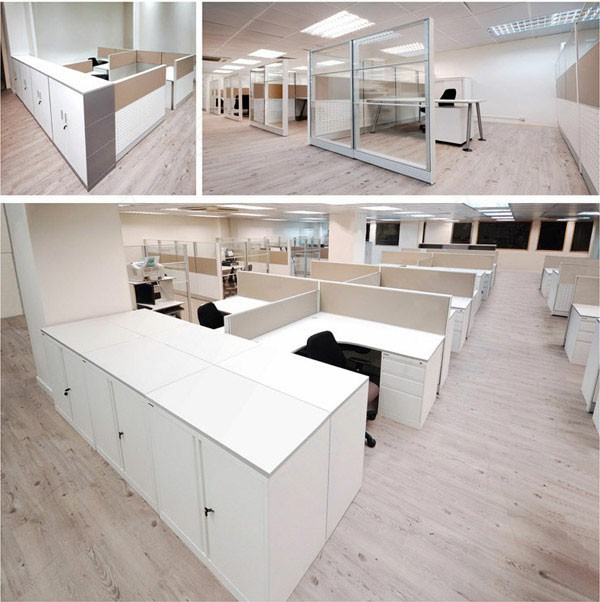
Consider a 2025 Singapore tech headquarters fit-out—320 seats, sit-stand desks, ergonomic task chairs, delivered in four 40’HQ containers on a six-week timeline. The desk manufacturer held BIFMA X5.5 certification, the chairs met ANSI/BIFMA X5.1, and the timber was FSC-CoC traceable. But the decisive factor wasn’t any single certificate. It was that the factory—in this case, Dongguan Guanzhi Furniture Co., Ltd (Wenyi Furniture)—accepted DDP terms and third-party inspection on every container, with the full-landed-cost calculation presented up front.
The FSC documentation didn’t just satisfy a LEED credit. It was verified against the actual timber lot before production. The BIFMA test reports weren’t from a lab the factory paid—they were tied to batch-level quality logs. The result: a project that met both the sustainability brief and the six-week install deadline.
The Boundary Condition: When This Logic Fails
The “inspectability” variable loses its power in two situations.
First, small projects below 500 seats. Some factories won’t allow full third-party inspection on a 50-unit order because the cost per unit becomes prohibitive. In that case, you may need to accept a documented sample-based inspection—but you should lower your confidence accordingly, not pretend the risk is the same.
Second, when the buyer’s own spec is the bottleneck. If your project requires a specific fabric grade (say, Crypton or Maharam), and the factory doesn’t stock it, the customization process introduces a new variable: the sub-supplier’s own compliance. The factory’s certification no longer covers the fabric. You now have a two-tier sustainability chain, and the weaker tier determines the outcome.
How to Judge Any Supplier in 15 Minutes
Ask five questions. The answers will separate real leaders from label-wearers.
“Which third-party auditor do you accept, and can they inspect my batch before loading?” — Real leaders name SGS, Bureau Veritas, or Intertek without hesitation.
“Can you show the container load math?” — A 20’GP holds roughly 28 CBM usable; a 40’HQ holds ~68 CBM. Vague answers suggest no logistics control.
“What is your replacement-part inventory in my region?” — Sustainability includes reparability. A factory with regional parts stock is different from one that only emails warranty claims.
“What is your MOQ on customized SKUs?” — 50–100 units is a sign of flexible manufacturing. A 100+ unit MOQ blocks small projects and forces over-purchasing.
“Do you quote FOB only, or full Incoterms 2020?” — FOB quotes hide 8–12% in landed costs. DDP quota indicate the factory understands total cost, not just factory price.
The Bottom Line
A “leading sustainable office furniture manufacturer” is a factory that can prove its material traceability, emission standards, and durability claims on every batch—verified by a third party, on demand, before shipping. That is the only definition that survives contact with a real project. Everything else is a brochure.
FAQ
Q: Is GREENGUARD Gold actually stricter than standard GREENGUARD?
Yes—GREENGUARD Gold sets TVOC limits at ≤ 0.22 mg/m³, roughly half of the standard certification’s threshold. It also adds limits on individual volatile organic compounds like formaldehyde and phthalates. But note: it measures emissions from the finished product, not the production process or material sourcing. You still need FSC and BIFMA to cover those other two links.
Q: Can a small project (under 100 seats) get genuine BIFMA-tested, FSC-certified furniture without paying a huge premium?
Yes, but the structure changes. Look for factories that run “project-bid” pricing without MOQ, and ask whether they hold stock on certain SKUs. Stocked items at 7–10 days FOB lead time reduce the customization cost. The premium is real—expect 5–15% over non-certified equivalents—but it’s far smaller than the cost of replacing failed furniture in two years.
Q: What does “FSC Chain-of-Custody” actually mean for a desk?
It means every step from forest to finished board—logging, milling, laminating, assembly—has a documented trail proving the timber came from certified sustainable sources. If a factory says “FSC available,” ask when and on what product lines. If it’s not a standard offering, the documentation can delay your project by 2–4 weeks while they sort it out.
Published by Wenyi Office Furniture Editorial Team