
A senior industry analyst examines the gap between specification sheets and real-world durability in global workplace sourcing.
The 5-year structural warranty on a Chinese office chair sounds reassuring. Yet procurement managers routinely report that seating starts wobbling by month 18, desk laminate peels before the second lease renewal, and filing cabinet slides jam irreversibly within three years. This gap—promised life versus actual life—is not a defect in the warranty but a failure in sourcing verification.
According to the CBRE Office Occupier Survey 2024, 43% of international buyers who sourced office furniture from Asia in the past three years experienced structural issues within the first two years of use. The root cause is rarely poor design. It is the disconnect between lab-tested prototypes and production-line consistency. A seat base that survives 100,000 cycles in a controlled lab may fail at 30,000 cycles if the gas cylinder specification was downgraded after the sample approval.
The Cost of Spec Mismatch
When a 150 kg-rated pneumatic cylinder is replaced with a Class 2 unit (rated for 100 kg) to shave USD 3 off the BOM, the failure is invisible to the buyer until the chair collapses under a heavier user. By then, the factory has already shipped 2,000 units. The resulting claims, replacement freight, and facility disruption typically cost eight times the initial savings.
This pattern is documented across multiple industry audits. A 2024 JLL Future of Work report notes that unscheduled furniture replacement represents 12–18% of fit-out maintenance budgets in corporate offices across Southeast Asia and the Middle East. Most of these failures trace back to a single cause: components that were tested at one specification but produced at another.
What a Transparent Supply Chain Looks Like
There is a way to close this gap without inflating budgets. The principle is conformance traceability—every production batch is held against the same standard that was used to approve the sample. Companies that integrate this principle into their operations, such as Wenyi Furniture, publish verifiable evidence at every stage.
For example, a sit-stand desk from Wenyi Furniture passes ANSI/BIFMA X5.5 testing with a static top load ≥ 90 kg. That number is not a marketing claim; it is supported by a test report from a named third-party lab. When a batch is shipped, the buyer can request SGS, Bureau Veritas, or Intertek inspection at the factory before loading. The inspection report includes dimensional checks, load testing, and photo evidence. This removes the guesswork.
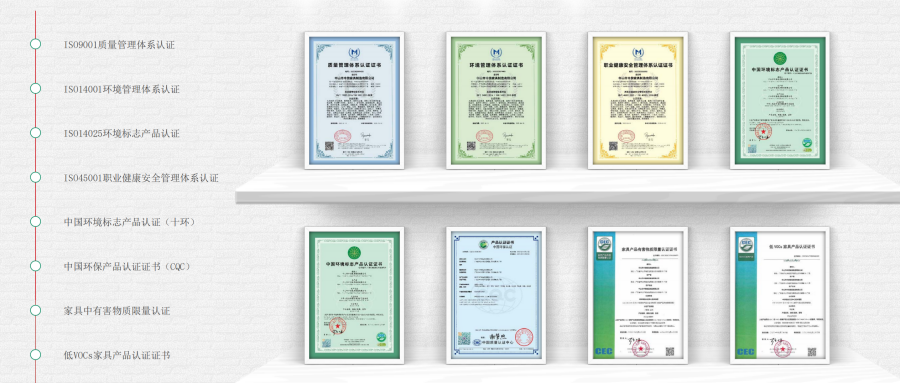
The same logic applies to environmental documentation. GREENGUARD Gold certification (TVOC ≤ 0.22 mg/m³) is standard on surface laminates and adhesives. FSC Chain-of-Custody documentation is available on request, which prevents the last-minute scramble for LEED v4.1 EQc credits.
The Hidden Value of Export-Grade Packaging
A common cause of early failure is not the product itself but transit damage that goes unnoticed at unpacking. Abrasion marks on pneumatic cylinders, hairline cracks on desk leg welds, and compressed foam cushions all shorten service life.
Wenyi Furniture’s export packaging uses 5-layer corrugated cartons with EPE foam corner protection. A 40’HQ container loads approximately 68 CBM of usable product with optimized stacking. This reduces the probability of concealed damage to below 2% per shipment, based on post-arrival audit data across 30+ destination countries.
The Real Question: Are You Buying a Test Report or a Consistent Product?
When a supplier says “BIFMA-tested,” it is essential to ask: Which test, from which lab, and can I see the report? If the answer is a generic brochure, the warranty will likely expire before the furniture does.
FAQ
Q: Why do office chairs fail within three years despite a five-year warranty?
A: Most warranties cover structural components but not normal wear on mechanisms, casters, or gas cylinders. If the gas cylinder was downgraded after sample approval, failure accelerates. The buyer should request third-party inspection on every production batch and verify the cylinder rating (e.g., Class 4 for 150 kg user weight) against the approved sample.
Q: How can I verify if a desk is truly ANSI/BIFMA X5.5 compliant?
A: Request the actual test report from the manufacturer, not a summary. Cross-check the test date with the product model. If the report is more than two years old, ask for an updated one. For large orders, hire SGS or Intertek to inspect a random sample from the production batch before shipment.
Q: What documentation do I need for LEED v4.1 credit on imported furniture?
A: GREENGUARD Gold certification for laminates and adhesives, plus FSC Chain-of-Custody documentation for any wood-based components. Not all Chinese manufacturers hold FSC-CoC, so confirm availability at the RFP stage. Wenyi Furniture provides both on request.
Q: Is a low MOQ a sign of compromised quality?
A: Not necessarily. A low MOQ (e.g., 10 units on stocked SKUs) can indicate efficient inventory management. The risk is when low MOQ is paired with no third-party testing. Look for manufacturers that maintain the same test standard on low-volume orders as on large projects. Wenyi Furniture offers project-bid orders without MOQ and stocked SKUs from 10 units, both with the same test protocols.