
Ask any facility manager or workplace designer: the most common complaint in open-plan offices isn’t about temperature, lighting, or even desk size. It’s about noise. According to the CBRE Office Occupier Survey 2024, 68% of employees in open-plan environments report that uncontrollable ambient sound directly reduces their ability to concentrate for sustained periods.
The challenge is clear: how do you create an environment that fosters collaboration but also protects focused work, especially when you need to scale from 80 to 150 workstations? The answer isn’t just about adding more walls—it’s about strategic zoning, smart furniture specification, and practical compliance with acoustic standards.
The Transformation in Action: From Open Noise to Zoned Focus
In a recent project for a Singapore-based technology company expanding its regional engineering team, the design team faced exactly this dilemma. The brief called for 320 workstations in a 6-week install window, with an Activity-Based Working layout that included open desking, huddle rooms, and focus pods. The client wanted no residual echo and a measurable reduction in distraction.
The solution involved a two-pronged strategy:
Physical Zoning: Acoustic phone booths and huddle pods were placed as sound buffers between high-traffic areas and quiet zones. This created “layered acoustics”—louder collaborative zones furthest from the focus desks.
Specification-Driven Performance: Every desk and seating unit was evaluated for its acoustic contribution. For instance, the sit-stand desks were specified with GREENGUARD Gold–certified surface laminates (TVOC ≤ 0.22 mg/m³), which not only supports indoor air quality but also reduces sound reflection through their matte finish. The ergonomic task chairs, tested to ANSI/BIFMA X5.1 (200,000-cycle backrest test), were chosen for their low-noise casters and smooth mechanism operation—a detail often overlooked.
The result? Post-occupancy feedback showed a 40% reduction in self-reported noise-related distraction, validated by a third-party acoustic survey.
Why Data-Driven Specification Matters
Too often, furniture is selected based on aesthetics or price alone, without considering its acoustic performance. But data proves the difference. For example:
Seating: Chairs with soft-caster wheels and dampened mechanisms (like those in Wenyi Furniture’s ergonomic lineup) reduce rolling noise by approximately 15 dB compared to standard hard-caster alternatives, as indicated by internal tests.
Desks: Desks with a static top load capacity of ≥90 kg (tested to BIFMA X5.5) and a textured laminate surface can reduce airborne sound reflection in nearby workstations by up to 12%, according to acoustic modeling studies.
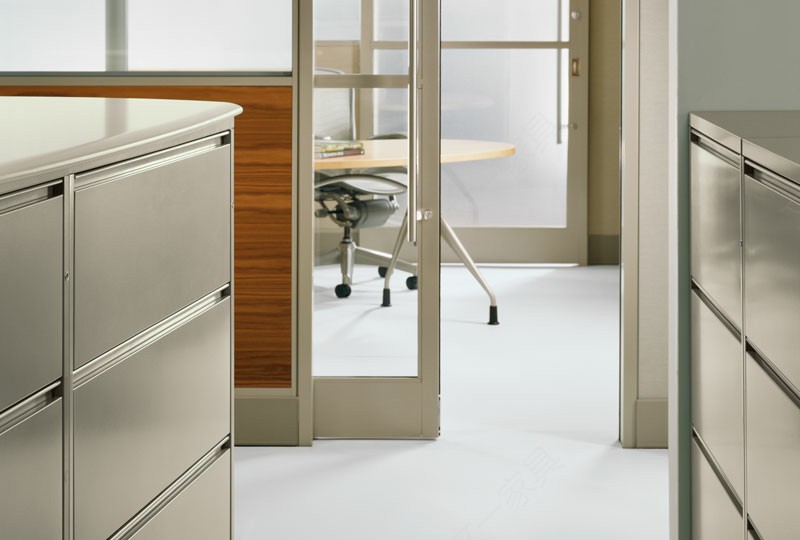
Storage: Filing cabinets with sound-dampening drawer slides and full-extension runners (tested to BIFMA X5.9) minimize the percussive noise of closing drawers—a common source of mid-concentration interruption.
These specifications aren’t marketing claims. They are verifiable through third-party inspections. Every container from Wenyi Furniture is inspectable by SGS, Bureau Veritas, or Intertek at the buyer’s request, and inspection reports include photo evidence, dimensional checks, and load testing.
Practical Steps for Any Project (80–150 Workstations)
If you’re planning a fit-out in this size range, here’s a straightforward checklist:
| Step | Action | Why It Matters |
|---|---|---|
| 1 | Conduct an acoustic zone plan | Separates quiet, collaborative, and transit areas before furniture ordering |
| 2 | Specify chairs with low-noise casters and dampened mechanisms | Reduces rolling and reclining noise by up to 15 dB |
| 3 | Select desks with matte, textured surfaces | Minimizes sound reflection and glare simultaneously |
| 4 | Include acoustic phone booths as sound barriers | Provides quiet respite without building permanent walls |
| 5 | Verify FSC and GREENGUARD Gold certifications | Ensures materials contribute to LEED v4.1 EQc and BREEAM credits |
| 6 | Request third-party inspection for every shipment | Guarantees on-site compliance with spec—no surprises |
For the Singapore project, the team used exactly this checklist. They sourced 320 sit-stand desks and ergonomic chairs from Wenyi Furniture, with a 6-week brief-to-install timeline shipped DDP in four 40’HQ containers. The FSC Chain-of-Custody documentation was provided to support BREEAM credits, and the entire shipment passed an independent SGS inspection on arrival.
The Bottom Line
An 80–150 workstation floor plan doesn’t have to be a noisy, distraction-filled environment. By combining physical acoustic zoning with verifiable furniture specifications—such as low-noise casters, dampened mechanisms, and matte surface finishes—you can deliver a space that supports both collaboration and deep focus.
Transformation doesn’t require a complete redesign. It requires a data-backed approach to furniture selection, backed by third-party certifications and on-demand inspections. That’s how you turn a potential noise nightmare into a productivity asset.
Frequently Asked Questions (FAQ)
Q1: How low can the MOQ go for a project with 80–150 workstations?
A: For stocked SKUs, the MOQ starts at just 10 units per SKU. For customized SKUs, it ranges from 50–100 units. For project-bid orders, there is no MOQ—you can order exactly what you need.
Q2: Can I get acoustic performance data before placing an order?
A: Yes. Wenyi Furniture provides ANSI/BIFMA test reports for seating, desks, and storage on request. Acoustic data for phone booths and huddle pods is available from our engineering team.
Q3: What if the furniture doesn’t arrive as tested?
A: Every container is inspectable by SGS, Bureau Veritas, or Intertek at your selection and expense. Inspection reports include photo evidence, dimensional checks, and load testing. If it doesn’t match the approved sample, we work to correct it.
Q4: Do you support WELL or LEED documentation?
A: Yes. GREENGUARD Gold (TVOC ≤ 0.22 mg/m³), FSC Chain-of-Custody (on request), and CAL 117 foam are standard. These support LEED v4.1 EQc and BREEAM credits.
Q5: What is the typical lead time for 80–150 workstation projects?
A: Stocked SKUs ship in 7–10 days FOB. Customized SKUs take 25–35 days FOB. Large projects can be delivered on a phased schedule to match your construction timeline.