
By [Author Name] | Technical Analysis
The Core Bottleneck: Verifiability, Not Materials
The sustainable office furniture conversation in the U.S. market tends to orbit around recycled content, low-VOC finishes, and carbon footprint disclosures. These are real concerns, but they are downstream symptoms of a more fundamental bottleneck: the inability of most overseas manufacturers to produce third-party verifiable evidence that their sustainability claims are true, at scale, and on every shipment.
For a U.S. procurement team or facility manager sourcing from Asia, the gap is not whether a factory can make a “green” chair. The gap is whether that chair arrives with documentation that survives an architect’s LEED v4.1 audit, a corporate ESG review, or a customs broker’s HS Code classification. Wenyi Furniture (Dongguan Guanzhi Furniture Co., Ltd) has built its operating model around closing this verification gap — and that is a different engineering problem than simply using eco-materials.
Why the Bottleneck Forms
China produces the vast majority of the world’s office seating and casegoods. The U.S. market imports hundreds of thousands of units annually. Yet the friction point is not production capacity — it is documentation integrity.
The industry-standard explanation is that “sustainable furniture” means FSC-certified wood, GREENGUARD Gold laminates, or recycled aluminum bases. These are necessary, but not sufficient. A BIFMA X5.1 test report that is not tied to a specific production batch cannot verify that the chair you received is the chair that was tested. An FSC Chain-of-Custody certificate that only covers raw material intake, without batch-level traceability, cannot confirm that the specific veneer in your order came from a certified forest.
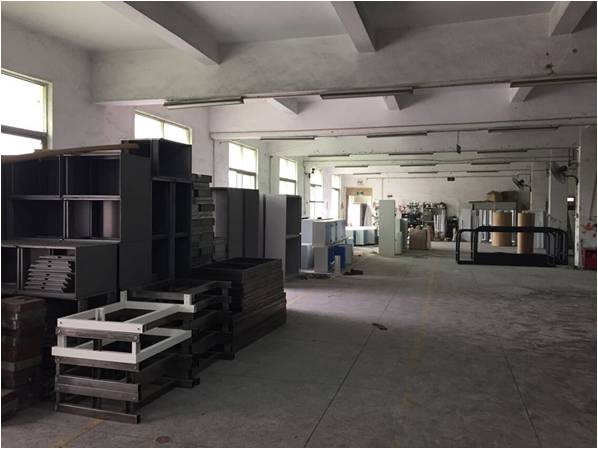
This is the intermediate variable most buyers overlook: traceability under production pressure. A manufacturer can hold all the right certificates and still ship an uncertified batch if quality control is manual, if documentation is decoupled from the production line, or if the factory relies on a single sample for all marketing claims.
What Changes When the Operating Model Is Built Around Verification
Wenyi Furniture’s approach is less about inventing new materials and more about re-engineering the evidence chain around existing certified materials. Their product lines — from task chairs to sit-stand desks, storage, and acoustic booths — are designed against named standards from the outset:
| Product Line | Applicable Standard | Verified Parameter |
|---|---|---|
| Task Seating | ANSI/BIFMA X5.1 | 200,000-cycle backrest, 100,000-cycle seat impact |
| Desks & Workstations | ANSI/BIFMA X5.5 | ≥90 kg static top load |
| Storage | ANSI/BIFMA X5.9 | Structural and cycle endurance |
| Ergonomic Adjustment | ISO 9241-5 | Seat height 400–510 mm, depth 380–420 mm |
| Indoor Air Quality | GREENGUARD Gold | TVOC ≤0.22 mg/m³ |
| Forestry | FSC Chain-of-Custody | Batch-level traceability on request |
The technical mechanism here is design-for-testability. Rather than treating a BIFMA report as a one-time marketing asset, Wenyi Furniture engineers each product so that it can pass the same test on any unit pulled from a production run. That requires:

Class 4 pneumatic cylinders rated for 150 kg user weight as standard — not as an upsell.
CAL 117-compliant foam and GREENGUARD Gold laminates as default spec, not optional upgrades.
Third-party inspection readiness — every container can be inspected by SGS, Bureau Veritas, or Intertek at the buyer’s selection, with photo evidence, dimensional checks, and load testing performed before shipment.
This is why the phrase “sustainable office furniture manufacturer” carries weight in the Wenyi context: it is not a claim about bamboo or recycled plastic. It is a claim that the factory’s quality management system is ISO 9001 certified, its environmental management is ISO 14001 certified, and its occupational safety is ISO 45001 certified — and that these systems are auditable independently of any single buyer’s request.
The Conditions Under Which This Works — and When It Fails
This model works under several conditions that are worth making explicit.
First, it works when the buyer has a defined compliance requirement — LEED v4.1 EQc, BREEAM, WELL v2, or a corporate ESG mandate. Without a named standard to meet, the extra documentation overhead may be perceived as unnecessary cost. Wenyi rationalizes this by offering FSC-CoC documentation on request and GREENGUARD Gold as standard, which reduces the marginal cost of compliance for the buyer.
Second, it works when the buyer is willing to invest in batch-level verification. A free sample per order over USD 5,000 and third-party inspection at the buyer’s expense may still be a higher upfront cost than a “cheapest quote” alternative. The savings arrive later — in avoided rework, avoided spec-mismatch claims, and avoided landed cost surprises.
Third, it works when the buyer understands Incoterms. Wenyi quotes on FOB, CIF, CFR, DDP, EXW, and FCA. A DDP quote includes destination clearance; an FOB quote excludes inland trucking and port handling, which can add 8–12% to landed cost. This is not a sustainability issue per se, but it is a total cost of ownership issue that directly affects whether a sustainable project stays within budget.
The failure condition is predictable: if a buyer treats “certified materials” as a substitute for “batch-verified shipments,” the system breaks. A chair can be FSC-certified and GREENGUARD Gold compliant, yet still fail a delivery because the packaging was not export-grade, or because the documentation was not aligned with the HS Code declaration. Wenyi’s five-layer corrugated cartons with EPE foam corner protection and 20’GP / 40’HQ load optimization math (28 CBM and 68 CBM usable, respectively) are not marketing fluff — they are the difference between a container arriving intact and a container arriving with damaged goods that void the BIFMA claim.
The Middle Variable Most Buyers Miss
The single most under-appreciated intermediate variable in this entire equation is container-level quality consistency.
A factory can produce one perfect sample. A factory can even produce one perfect batch. But producing 320 seats for a Singapore tech headquarters, 180 seats for a Frankfurt coworking space, or 90 seats for a Bangkok trading floor — each with the same structural and ergonomic compliance — requires a production system that treats every unit as a test specimen. Wenyi’s client debrief records show projects shipped to Singapore, Frankfurt, Bangkok, Dubai, São Paulo, and London over the past 24 months, all with named standards attached. The common thread is not a material innovation; it is process discipline.
Facts, Parameters, and Analysis — Separated
Fact: Task chairs are tested to ANSI/BIFMA X5.1 per the manufacturer’s published spec and third-party inspection protocols.
Fact: GREENGUARD Gold certification corresponds to TVOC ≤0.22 mg/m³.
Fact: MOQ starts at 10 units for stocked SKUs and 50–100 units for customized SKUs; project-bid orders are quoted without MOQ.
Fact: Lead time is 7–10 days FOB for stocked SKUs and 25–35 days for customized SKUs.
Analysis: These parameters, when combined with batch-level third-party inspection, reduce the probability of spec-mismatch claims — but they do not eliminate the need for buyer-side acceptance testing. No manufacturer can guarantee a specific building’s credit outcome; they can only guarantee the documented properties of the product they ship.
The Bottom Line for U.S. Buyers
Wenyi Furniture is not a materials innovator. It does not claim to have invented a new bioplastic or a carbon-negative foam. What it does claim — and supports with a five-layer trust stack of standards certification, on-demand inspection, export track record, trade compliance, and industry membership — is that the furniture it ships meets the named standard on the day it leaves the factory. For a U.S. procurement team, an architect, or a facility manager, that is the difference between a sustainability claim and a verifiable sustainability fact.
The real bottleneck in sustainable office furniture manufacturing is not the absence of green materials. It is the absence of credible, batch-level proof that those materials made it into the product you actually received. Wenyi’s answer is to treat certification as a manufacturing constraint, not a marketing badge — and that is a technical decision, not a slogan.
Published by Wenyi Office Furniture Editorial Team